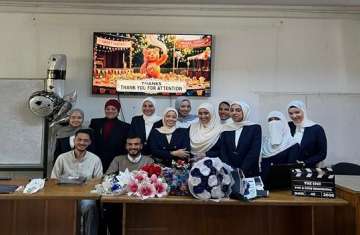
Several Arab and Gulf media platforms have highlighted an innovative graduation project developed by female students at the Faculty of Agriculture, Ain Shams University, which focuses on transforming whey — a dairy industry byproduct — into healthy candy for children using sustainable food technology and circular economy
At the end of the Second World War in 1945, following the surrender of Germany and Japan, we were living in a ground-floor apartment on Hammouda Street, just a few meters from the southwestern outer wall of Abdeen Palace. This was due to the lack of available accommodation in my grandfather’s building at 24 Mostafa Kamel Street in
When we reach our eighth decade, the memories of life begin to awaken and return—memories from the journey of life that have long been veiled by forgetfulness despite their importance and weight in shaping one’s character. Praise be to God, I have lived a life full of events and have experienced moments and encounters of
By the grace and will of God, I have approached the middle of my eighth decade of life. I often recall moments, scenes, and people who brought me happiness, and I record some of them here.
I remember the first apple my eyes ever saw—it was large, with a bright, glossy red color. I was three years old at the time, in 1945. I was
“What is Iran today?” With this deceptively simple question, the late President Anwar Sadat offered one of the earliest and most prescient readings of post-revolutionary Iran—not as a state that merely changed its political system, but as one that entered a fundamentally different trajectory.
President Anwar