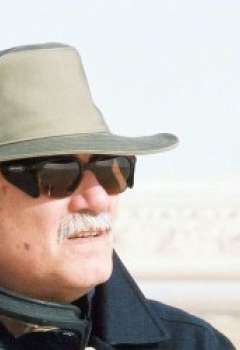
By the grace and will of God, I have approached the middle of my eighth decade of life. I often recall moments, scenes, and people who brought me happiness, and I record some of them here.
I remember the first apple my eyes ever saw—it was large, with a bright, glossy red color. I was three years old at the time, in 1945. I was accompanying my father and my infant brother on our journey back to Egypt after eight years during which my father had been forcibly prevented from returning home due to the horrors of the Second World War. We had been living in the city of London following my father’s attainment of a doctorate with honors from the London School of Economics, and his repeated but unsuccessful attempts to return, as air and sea transport had been entirely devoted to the war effort.
Finally, in 1945, under strict security supervision, a decision was issued allowing us to leave Britain by sea as part of a naval convoy, on the condition that we depart immediately. Space was allocated for civilian passengers in the lower deck of one of these ships. Among us was a British woman married to an Egyptian, who kept entertaining me throughout this terrifying journey—terrifying due to the German submarine attacks that destroyed Allied ships. At the end of the journey, she gifted me that apple. Only God knows the extent of my joy and amazement at such a rare gift at the time.
I move forward a few years, to 1948. We lived in an apartment on the second floor in the Abdeen district. From the balcony, I would watch the muezzin of the nearby mosque calling to prayer from the minaret, turning in a circular motion within its balcony so that his voice could reach all residents of the neighborhood, as microphones did not exist then. Every morning, I would also see a worker carrying a long pole with a metal funnel at its end, passing by the streetlight posts equipped with gas lamps, extinguishing each flame. Street lighting at night was dim.
During the month of Ramadan, I enjoyed watching the neighborhood children carrying small lanterns lit by candles, playing in the street below us. Because the street lighting was faint, it felt as though one were watching stars moving here and there, accompanied by joyful Ramadan songs chanted by the children, such as “Wahawi Ya Wahawi.” From time to time, a “sanduq al-dunya” performer would pass by, and we would rush toward him, paying half a piaster to sit on a wooden bench. He would cover us with a cloth to block out the light and begin turning a handle that animated drawings accompanied by music, allowing us to watch these moving images with wonder and delight.
In 1950, we moved from the Abdeen apartment to a villa in the Maadi district. Only God knows the extent of our happiness with the flourishing garden that surrounded the villa, and the trees crowned with flowers throughout Maadi—crowns of red, yellow, or blue blossoms spread abundantly across the area. The villa’s proximity to a canal and a village connected us to its residents through daily interactions.
Every morning, a peasant woman would enter our garden, leading a buffalo. We would give her a small stool and a pot; she would sit and milk the buffalo until the pot was filled with milk. We would then pay her, and she would leave, returning to the village. As children, we would carry the full pot to the kitchen, where my mother would boil the milk, skim off the cream into a dish, and we would all gather around it, pouring black molasses over the cream and devouring this beloved meal within minutes.
We would often hear the music of the Hasaballah band as it marched through the streets of Maadi once a week. Children and adults from the village would follow the band joyfully for long distances, clapping whenever a performance ended.
We also watched peasant women passing by the villa wearing veils adorned with coins or embroidered with colorful threads, as well as young women wearing Bedouin-style headscarves with decorative, patterned edges. One of the most captivating sights for us was the bridal procession passing in front of our home: a camel carrying a beautifully colored fabric howdah that held the bride, followed by around five donkey-drawn carts loaded with her belongings. Sitting atop the furniture were children and women clapping and singing wedding songs, all heading toward the village where the groom awaited at their marital home.
We also followed various activities at the historic Maadi Club. Every Sunday, foreign and Egyptian communities would gather to watch American baseball games or competitions of model helicopters, which young men crafted skillfully in different sizes. The maker would stand in the football field, place the model on the grass, spin its rotor with his fingers, then step back about fifteen meters while remaining connected to it by wires. The model would rise to a height of about ten meters and begin circling, while its operator stood in place, turning with it and maintaining control until its fuel ran out and it descended.
Radio broadcasting was rich and diverse, offering programs suitable for all listeners. In the mornings, there were children’s programs presented by Baba Sharo, through which we enjoyed songs and stories such as the adventures of Tarzan in the jungle. This was followed by the wonderful episodes of “One Thousand and One Nights,” along with other engaging series such as “Al-Dawwama” and “Samara.” As for adults, they eagerly awaited the monthly performances of the Star of the East, gathering around the radio with all the accompanying elements of a traditional coffee setting—such as the cezve, the small stove, cups, and coffee roasted and ground at home, filling the air with its distinctive and beloved aroma, along with bottles of water. These were complete preparations to focus and enjoy the voice of Egypt’s and the Arab world’s beloved icon—may she rest in peace.
Finally, I had the honor of interacting with Egyptian giants such as Gamal Abdel Nasser and his wife, Mahmoud Fawzi, former Vice President and Minister of Foreign Affairs, the brilliant architect Hassan Fathy, Sheikh Abdel Halim Mahmoud, Sheikh Mohamed Metwally Al-Shaarawy, Dr. Hamed Gohar, the journalist Saeed Sanbal, Field Marshal Mohamed Fawzi, who played a key role in rebuilding and preparing the army in the years following the setback, enabling it to successfully fight the October War, Lieutenant General Saad El-Shazly, the architect of the 1973 war, and Field Marshal Mohamed El-Gamasy. These are deeply rich memories that will never fade. Praise be to God.








 follow us in google news







Comments