In a strategic move aligning with regional and global trends towards smart cities and mobility solutions, a research team at the American University in Cairo (AUC) is leading a pioneering project to reshape the future of autonomous vehicles (AVs). The project focuses on the most significant hurdle facing the commercial adoption of these technologies: complex ethical decision-making and building human trust.
Led by Dr. Amr El Mougy, Associate Professor at the Department of Computer Science and Engineering, the multidisciplinary team recently reached a major milestone by successfully operating a vehicle remotely. Users were able to drive a golf cart inside the university's Autonomous Systems Lab using an Android smartphone and an internet connection. Established in 2023, the lab serves as an advanced regional hub for AI and autonomous driving research.
Innovating an AI "Black Box"
To meet the rigorous transparency and safety demands of both investors and regulators, the team is developing a dedicated "black box" for autonomous vehicles, modeled after those used in the aviation industry. This technology aims to document and interpret the exact mechanisms behind the smart systems' decisions during critical moments—especially when errors occur or when the system faces conflicting data. This breakthrough represents a paradigm shift in how smart traffic incidents will be evaluated in the future.
Reinforcement Learning: How Do the Cars of Tomorrow Think?
In parallel with hardware developments, the team is working on an integrated research project titled "Ethical, Trustworthy, and Autonomous: Vehicles of Tomorrow." The project relies heavily on Reinforcement Learning, a branch of AI that trains systems to make safe decisions based on a framework of rewards and consequences, mirroring human and animal learning processes.
During a recent media roundtable hosted as part of AUC's “Meet an Expert” initiative, Dr. El Mougy explained the system's mechanics: "If sensors are the eyes and ears of autonomous driving systems, algorithms are the brain." He detailed how sensors continuously build an instant visual scene of the surroundings. Once a passenger inputs a destination, the system integrates this real-time environmental data to make precise decisions regarding acceleration, steering, and braking.
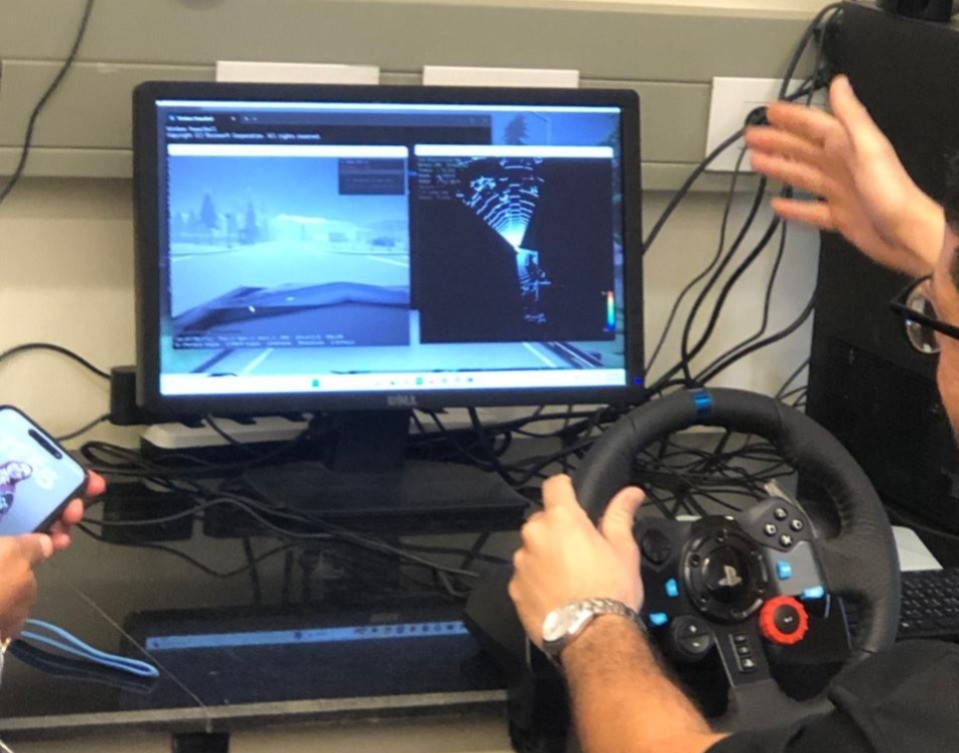
Virtual Reality Simulations to Boost Consumer Trust
The researchers are rigorously testing human interaction with these technologies through advanced Virtual Reality (VR) environments developed in-house. These environments simulate complex, real-world driving scenarios, including situations involving misleading information, to gauge passengers' readiness to trust the machine.
Highlighting the behavioral economics of AV adoption, El Mougy noted: "Every time I give a seminar on autonomous driving, I ask the audience about their willingness to ride in an autonomous vehicle. I always find at least one or two people who completely reject the idea, and their stance is almost always rooted in a lack of trust."
Strategic Funding to Accelerate Tech Innovation
Underscoring the economic and technical viability of the project, the research secured $300,000 in funding in 2025 from the African Engineering and Technology Network (Afretec)—a consortium of nine universities dedicated to accelerating digital growth across the continent through scientific research.
The research team aims to leverage this funding to expand data collection and develop a more robust testing infrastructure. As global markets inch closer to adopting fully autonomous mobility systems, studies like these emerge as crucial catalysts for shaping regulatory policies and building the public confidence necessary to guarantee the success of smart mobility investments


 follow us in google news











Comments